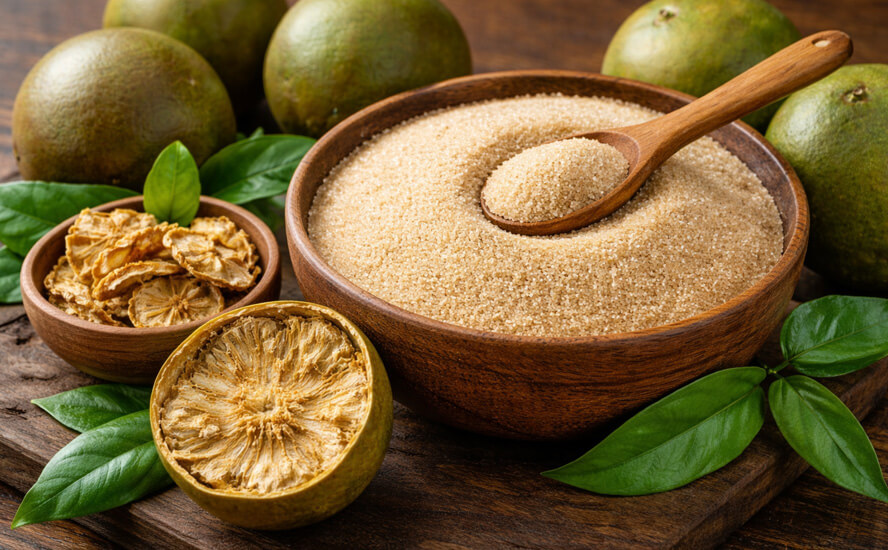
Many food manufacturers assume that replacing sugar with monk fruit extract is a simple substitution. In practice, it is not that straightforward. Monk fruit extract delivers intense sweetness at a very small fraction of the weight of sugar, while sugar itself does far more than sweeten a formulation. This is precisely where monk fruit extract bulking agents enter the conversation.
Bulking agents and carrier systems are not a universal requirement for every monk fruit product. They become relevant in specific applications where sugar’s physical contribution, not just its sweetness, needs to be replaced. Understanding this distinction helps formulators make informed, application-specific decisions rather than assuming a one-size-fits-all approach.
Monk Fruit Extract Provides Sweetness, Not the Same Bulk as Sugar
Monk fruit extract is classified as a high-intensity sweetener. Depending on the mogroside concentration of the extract, it can be many times sweeter than sugar by weight. As a result, manufacturers use it at inclusion levels that are a small fraction of the sugar quantity it replaces.
This is the core formulation challenge. Sugar is added to a recipe in large quantities, often making up a significant percentage of the total formula weight. A monk fruit extract with high sweetening power achieves the same perceived sweetness at a much lower dosage. When a formulator swaps sugar for monk fruit extract on a strict one-to-one weight basis, the missing sugar volume leaves a physical gap in the formulation that sweetness alone cannot fill.
This is why direct, unadjusted replacement is rarely straightforward. The sweetening function and the bulk function of sugar need to be evaluated separately.
What Does Sugar Contribute Besides Sweetness?
Sugar performs several roles in a food formulation beyond taste. Depending on the product category, sugar can contribute to:
- Bulk and solids, giving batters, doughs, and mixes their expected volume
- Texture and body, affecting how a product feels in the mouth
- Moisture management, since sugar is hygroscopic and influences shelf stability
- Browning, through Maillard reaction and caramelization in baked goods
- Structure, supporting crumb formation in cakes and biscuits
- Processing behavior, including how batters flow, set, or crystallize
When sugar is significantly reduced or removed, a formulation can lose some of these physical and functional properties, even if sweetness is fully restored using a concentrated sweetener. This is a formulation issue, not a flavor issue, and it is the primary reason bulking agents are discussed alongside high-intensity sweeteners like monk fruit extract.
Why Are Bulking Agents Used With Monk Fruit Extract?
A bulking agent or carrier ingredient is typically introduced to address the volume and handling gap created by sugar reduction, not to add sweetness. Common reasons formulators consider a bulking system include:
- Restoring physical volume lost when sugar is reduced
- Supporting texture and mouthfeel closer to the original product
- Improving the handling characteristics of a highly concentrated sweetener
- Making a low-dosage ingredient easier to measure and dose accurately
- Supporting uniform distribution of sweetness throughout a mix
- Helping a formulation reach its intended solids or weight targets
It is worth separating these two functions clearly. The sweetening function is handled by the monk fruit extract itself. The bulking function, when needed, is handled by a separate carrier or bulking ingredient chosen for the specific application. Combining a monk fruit sweetener with an appropriate bulking system allows formulators to manage both requirements without over-relying on either ingredient for a job it was not designed to do.
Monk Fruit Extract and Bulking Agents in Different Food Applications
The need for a bulking agent or carrier is not uniform. It depends heavily on how much sugar is being replaced and what physical role that sugar was playing in the specific product.
1. Bakery Products
Cakes, biscuits, and cookies rely on sugar for volume, structure, moisture retention, and browning. Replacing a large proportion of sugar in these products creates a more noticeable loss of solids and bulk. Formulators working on bakery reformulations often need to evaluate additional ingredients to help compensate for some of sugar’s physical functions, in addition to using monk fruit extract for sweetness.
2. Beverages
Beverages generally require far less physical bulk from the sweetener itself, since liquid products depend more on dissolved solids and mouthfeel than on structural volume. A concentrated monk fruit extract can often work at a low dosage in beverage applications, sometimes with only minor formulation adjustments rather than a dedicated bulking agent.
3. Dairy and Dairy Alternatives
In dairy and dairy-alternative products, sweetness needs to be balanced against body, viscosity, and mouthfeel, which are already influenced by fat content and other solids. Depending on the degree of sugar reduction, formulators may need to fine-tune texture separately from sweetness.
4. Confectionery
Confectionery is one of the more complex categories, since sugar often plays a structural role in crystallization, chewiness, and set. Significant sugar reduction in confectionery can require careful evaluation of bulking or texturizing systems alongside monk fruit extract.
5. Powdered Food and Beverage Products
Highly concentrated monk fruit extract can be difficult to dose uniformly when only a small amount is needed per serving. In powdered drink mixes and similar products, a suitable carrier can improve flow, dispersion, and dosing consistency, helping ensure that each serving delivers consistent sweetness.
6. Nutraceutical and Functional Products
Powdered nutraceutical and functional food formats often face the same dosing and handling considerations as other powdered products. An appropriate carrier system can support accurate, consistent inclusion of a concentrated sweetener in these formats.
Bulking Agent vs Carrier: Are They the Same?
The terms “bulking agent” and “carrier” are often used interchangeably in practical ingredient discussions, though they can serve distinct purposes depending on the formulation.
| Term | Primary Function |
| Bulking Agent | Adds physical volume, weight, or solids to replace lost bulk |
| Carrier | Improves handling, dispersion, and dosing accuracy of a concentrated ingredient |
| Processing Aid | Supports a specific processing step without necessarily remaining functional in the final product |
In many real-world applications, a single ingredient may perform more than one of these roles at once. Industry usage of these terms varies by application and by formulator, so the important consideration is what functional gap needs to be addressed, rather than the label applied to the ingredient.
What Should Formulators Consider When Choosing a Bulking Agent?
Selecting the right bulking or carrier ingredient for a monk fruit extract formulation depends on several application-specific factors, including:
- The food or beverage application and its processing conditions
- The degree of sugar reduction or replacement
- Required texture, solubility, and moisture behavior
- Sweetness intensity and desired sweetness profile
- Nutritional and label targets, including clean-label positioning
- Cost and sourcing considerations
- Regulatory requirements in the target market
- Consumer taste and texture expectations
Because these variables differ by product, formulators should evaluate potential bulking or carrier ingredients through application-specific trials rather than assuming a single system will work across every format.
Does Every Monk Fruit Product Need a Bulking Agent?
No. Not every monk fruit formulation requires a bulking agent. The need depends on the product format, the inclusion level of monk fruit extract, and how much sugar or other bulk ingredient is being replaced.
In applications where the sweetener contributes little physical bulk to begin with, such as many beverages, monk fruit extract can often be used effectively with limited or no additional bulking system. In applications where sugar was playing a significant structural or textural role, such as bakery or confectionery, formulators are more likely to need a bulking or carrier ingredient to help restore some of that lost functionality. The right approach is always determined by the specific formulation goals, not by a blanket rule.
How Monk Nectar® Supports Monk Fruit Ingredient Requirements
Formulating with monk fruit extract involves more than sourcing a sweetening ingredient. It requires understanding how that ingredient behaves within a specific application, alongside the other components of a formulation.
Monk Nectar® works with food manufacturers, beverage producers, nutraceutical brands, and formulators across India as a supplier of monk fruit ingredients, with an understanding of the practical formulation questions that come up during sugar reduction projects. For businesses evaluating monk fruit extract for bakery, beverage, dairy, confectionery, powdered, or functional food applications, discussing specific formulation goals, dosage requirements, and application details can help identify the right ingredient approach for the product at hand. Manufacturers and formulators considering a shift toward natural, low-calorie sweetening solutions are welcome to reach out to Monk Nectar® to discuss application-specific requirements and bulk sourcing needs.
FAQs
1. Why does monk fruit extract need a bulking agent?
Monk fruit extract is a high-intensity sweetener used at very low inclusion levels, while sugar contributes significant physical bulk, texture, and structure to many formulations. When sugar is substantially reduced, some applications may need a bulking or carrier ingredient to help restore volume, texture, or dosing consistency.
2. Does monk fruit extract provide the same bulk as sugar?
No. Monk fruit extract is used in very small quantities compared to sugar because of its sweetness intensity, so it does not naturally replace the volume, solids, or structural role that sugar provides in a formulation.
3. What can be used as a carrier for monk fruit extract?
Carrier selection depends on the specific application, required texture, solubility, and label goals. Formulators typically evaluate options through application-specific trials rather than relying on a single universal carrier.
4. Is a bulking agent required in every monk fruit sweetener formulation?
No. The need for a bulking agent depends on the product format and the extent of sugar replacement. Some applications, such as certain beverages, may require little to no additional bulking ingredient, while others, such as bakery or confectionery, are more likely to need one.
5. How do food manufacturers formulate monk fruit extract for different applications?
Manufacturers assess sweetness targets, required texture, processing conditions, and label requirements for each specific application, then determine whether a bulking or carrier ingredient is needed alongside monk fruit extract to achieve the desired final product characteristics.
Conclusion
Choosing the right monk fruit ingredient system depends entirely on your specific application, target sugar reduction, and processing requirements. If your team is evaluating monk fruit extract for a bakery, beverage, dairy, confectionery, powdered, or functional food product, Monk Nectar® is available to discuss your formulation goals and help identify a suitable ingredient approach. Contact Monk Nectar® today to discuss your application requirements, request bulk pricing, or explore monk fruit sourcing options tailored to your business.