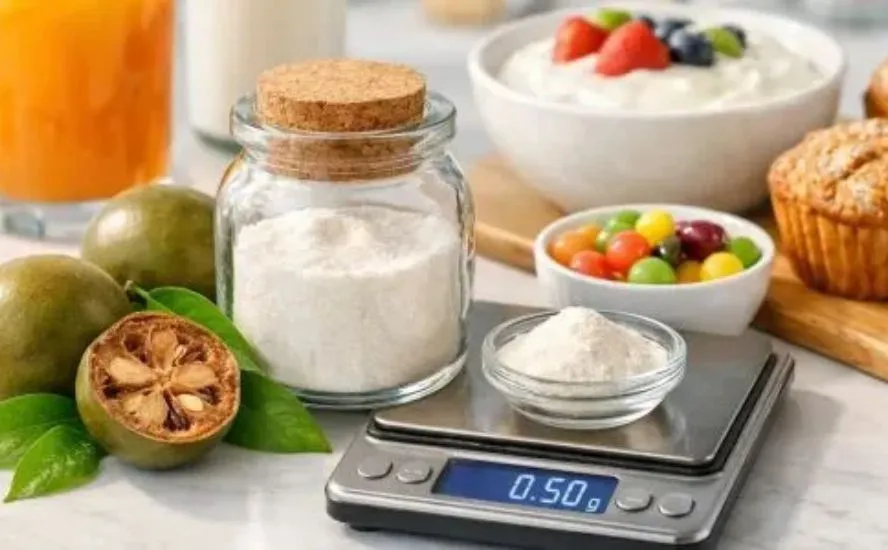
A sweetener quotation tells you what you pay per kilogram at the factory gate. It does not tell you what each bottle, bar, sachet or tub costs you to sweeten. That gap explains why a sweetener that looks expensive on a price list can behave very differently once it enters a formulation, and why a cheap-looking one can cost more than expected after you add bulking agents, rework and extra handling.
Monk fruit extract cost-in-use is the amount an ingredient adds to the cost of one finished unit or serving, calculated at the real inclusion rate in your formulation. It combines the purchase price per kilogram, the quantity you need to reach your sweetness target, the other ingredients and processing steps that the choice triggers, and the number of saleable units you produce.
This guide shows manufacturers how to calculate monk fruit extract cost-in-use, how to compare it fairly with sugar, stevia and other natural sweeteners, which factors shape quotations, and what to ask a supplier before you commit to bulk sweetener sourcing. All figures in the worked example are hypothetical, so replace them with verified quotations and your own trial data.
What Does Monk Fruit Extract Cost-in-Use Mean?
Cost-in-use measures the economic effect of an ingredient on your finished product. Purchase price measures only the cost of buying the ingredient. The two numbers answer different questions, and procurement, R&D and finance teams need both.
Price per kilogram, cost per batch, cost per unit and cost per serving
Four measures describe the same ingredient at different stages:
- Price per kilogram is the quoted cost of the ingredient as you buy it.
- Cost per batch is the price per kilogram multiplied by the kilograms used in one production run.
- Cost per finished unit is the cost per batch divided by the number of saleable units that batch produces.
- Cost per serving divides the same cost by the number of servings in each unit, which matters for powders, supplements and multi-serve packs.
A high price per kilogram can still produce a modest cost per serving when the inclusion rate is very small. A low price per kilogram can produce a large cost per serving when the formulation needs a large quantity. Neither outcome is automatic, so you need to calculate it.
Why procurement teams should look beyond the quoted price
Buyers who rank sweeteners by price per kilogram compare the quantity they buy, not the result they get. A better question asks what it costs to reach the same sweetness, taste, texture and shelf-life target in the finished product. Monk fruit extract is a high-intensity sweetening ingredient built on mogrosides, so its inclusion rate sits far below the rate for sugar. That difference makes cost-in-use the more useful lens for monk fruit extract for manufacturers.
How Do Manufacturers Calculate Monk Fruit Extract Cost-in-Use?
Start with the ingredient only, then widen the calculation to include everything the choice changes in your production process.
The step-by-step method
- Record the ingredient purchase price per kilogram from a written quotation that states the specification.
- Set the actual inclusion rate from your formulation, expressed as a percentage of batch weight.
- Calculate the quantity used per batch in kilograms.
- Calculate the ingredient cost per batch.
- Count the saleable finished units or servings from that batch.
- Divide to find the ingredient cost per unit or serving.
The core formulas are:
- Quantity used per batch (kg) = Batch weight (kg) × Inclusion rate (%) ÷ 100
- Cost of ingredient per batch = Ingredient price per kilogram × Quantity used in the batch in kilograms
- Cost per finished unit = Ingredient cost per batch ÷ Number of saleable finished units
- Cost per serving = Cost per finished unit ÷ Servings per unit
Illustrative calculation (hypothetical figures only)
The numbers below are invented for teaching. They are not Monk Nectar® prices, market averages or recommended inclusion rates. Actual results depend on verified supplier pricing and application-specific formulation trials.
Assumptions: one batch weighs 1,000 kg and fills 4,000 units of 250 g each (1,000 kg ÷ 0.25 kg = 4,000 units). The sweetening ingredients below are hypothetical and deliver the same target sweetness.
| Ingredient (hypothetical) | Price per kg | Inclusion rate | Quantity per batch | Cost per batch | Cost per unit |
| Monk fruit extract | ₹20,000 | 0.05% | 0.5 kg | ₹10,000 | ₹2.50 |
| Sugar | ₹50 | 8.00% | 80 kg | ₹4,000 | ₹1.00 |
| Stevia-type high-intensity sweetener | ₹12,000 | 0.08% | 0.8 kg | ₹9,600 | ₹2.40 |
The working for monk fruit extract: 1,000 kg × 0.05% = 0.5 kg. Then ₹20,000 × 0.5 kg = ₹10,000 per batch. Then ₹10,000 ÷ 4,000 units = ₹2.50 per unit.
In this made-up scenario, sugar costs less per unit on an ingredient-only basis. That result is a legitimate outcome, and the example is not an argument that one sweetener always wins. Sugar also delivers bulk and body, and it cannot support a sugar-reduction claim, so the comparison only makes sense when the product targets allow it.
From ingredient-only cost to broader production cost
A fuller assessment adds the costs that the sweetener choice changes. Using the same hypothetical monk fruit extract scenario:
- Ingredient cost per batch: ₹10,000
- Extra body or mouthfeel ingredient needed after removing sugar: ₹2,500
- Allocated quality-control testing: ₹500
- Total sweetening-related cost per batch: ₹13,000
- Saleable units after 2% wastage (4,000 − 80): 3,920
- Cost per saleable unit: ₹13,000 ÷ 3,920 = ₹3.32
Run the same wider calculation for every candidate sweetener, including handling, processing changes, rework and yield loss. Keep the ingredient-only table and the broader production-cost table separate, because they answer different questions.
Why Does Price per Kilogram Alone Mislead Manufacturers?
Price per kilogram ignores five variables that decide the real economics of a sweetener.
Sweetness intensity. A concentrated ingredient needs a smaller dose than a weaker one to reach the same target. Intensity depends on the extract, so sweetness equivalence is not a single universal number.
Specification. Mogroside content, extract concentration, purity and form (powder or liquid) all change how much you need. Monk Nectar®’s product page lists several powder grades by mogroside percentage plus a liquid grade, which shows how widely specifications can differ even within one supplier. A quotation for one grade does not compare directly with a quotation for another.
Application. Beverages, dairy, bakery, confectionery, frozen desserts and supplements stress a sweetener differently through heat, acidity, moisture and storage.
Target sweetness. A mildly sweet product and an intensely sweet one need different dosing even when the ingredient stays the same.
Usage rate in practice. Theoretical ratios from brochures rarely match the dose a panel actually approves.
For these reasons, do not apply a fixed replacement ratio from a general article, including this one. Ask the supplier for technical documentation for the exact grade, then run controlled formulation trials in your own base. Set the inclusion rate from trial data, then calculate cost-in-use.
How Does Monk Fruit Extract Compare With Sugar, Stevia and Other Sweeteners?
A fair comparison uses the same criteria for every ingredient. Use the checklist below for monk fruit extract versus sugar, monk fruit extract versus stevia, and monk fruit extract versus other natural sweeteners.
| Criterion | What to check |
| Price and usage rate | Quoted price per kg at the inclusion rate your trials support |
| Sweetness intensity | Intensity at your target sweetness level, in your own base |
| Taste profile | Sensory panel results for onset, lingering sweetness and any off-notes |
| Functionality | Bulk, texture, moisture retention, browning and freezing behaviour |
| Compatibility | Interaction with acids, proteins, flavours, colours and other sweeteners |
| Bulking needs | Whether you must add a bulking agent or other ingredient |
| Processing and stability | Heat, pH and shelf-life performance in your process |
| Labelling and regulation | Permitted use, declaration and claims in your target market |
| Total cost | Cost of reaching the required finished-product result |
What monk fruit extract does and does not replace
Monk fruit extract provides sweetness. It does not automatically replace the bulk, texture, moisture, browning or other functional roles that sugar plays in many recipes. A baked good, for example, may need a bulking agent or structural change after you remove sugar. Those additions belong in your cost-in-use calculation. Monk Nectar® itself notes that monk fruit sweetener does not caramelise like sugar, so browning needs attention in some formulations.
Keeping the comparison balanced
Sugar, stevia and monk fruit extract each suit different products. Sugar costs little per kilogram and brings functionality, yet it prevents sugar-reduction positioning. Stevia and monk fruit extract are both high-intensity ingredients with different taste profiles, and the better fit depends on your product and your panel results. Natural monk fruit extract appears across beverages, dairy, confectionery, bakery, frozen desserts and nutritional products, but suitability always depends on the formulation in front of you.
Check labelling and regulatory rules for each target market and product category before you finalise a choice. Permitted use levels, declaration terms and sugar-reduction claims differ between jurisdictions, so consult the rules that apply in India, the export markets you serve and your product category.
Which Factors Influence Monk Fruit Price in India?
Buyers searching for the monk fruit price in India often hope for one number. In practice, quotations depend on the commercial and technical terms attached to them, and no reliable single market price covers every specification. This article does not publish one for that reason.
Factors that can influence a monk fruit extract price quotation include:
- Extract specification and mogroside concentration. Higher concentration grades generally call for different processing than lower grades.
- Purity requirements. Single-ingredient extract and blended products carry different cost structures.
- Order quantity. Bulk price tiers and minimum order quantities can change the price per kilogram.
- Supplier documentation and quality requirements. Extra testing, certificates or customer-specific audits can affect terms.
- Packaging. Drum, bag and pack-size choices change cost and handling.
- Shipping and sourcing arrangements. Freight, location and import or domestic sourcing routes affect landed cost.
- Contract terms. Payment terms, delivery schedules and volume commitments can all shape the final figure.
Not every factor applies to every supplier or every order. To compare fairly, ask each supplier for an itemised quotation against the same specification, pack size and delivery terms. Monk Nectar®’s monk fruit price in India discussion on its product page gives a general sense of how product type and form influence price. For bulk requirements, request a quotation that reflects your own grade, volume and delivery needs.
How Can Manufacturers Control Sweetener Costs Without Compromising Quality?
Savings come from verified data. Theoretical ratios and supplier claims do not substitute for it. Work through these steps:
- Request comparable quotations. Send every supplier the same specification, quantity and delivery terms.
- Check technical specifications before comparing prices. Confirm the grade, mogroside content and form.
- Calculate cost at the actual inclusion rate. Use trial-approved doses, not brochure ratios.
- Run small-scale formulation and sensory trials before committing to commercial production.
- Evaluate the finished product. Judge taste, texture and stability together, not the ingredient alone.
- Track batch yield, wastage and rework. Small losses can outweigh a lower ingredient price.
- Review packaging, logistics and purchasing frequency. Minimum order quantities, storage space and reorder cycles affect working capital.
- Check batch-to-batch consistency and the availability of technical documentation.
- Assess knock-on effects. A change in sweetener can alter other ingredients, processing steps or quality requirements.
Validate any proposed saving through production trials and real formulation data. If the numbers show that another ingredient fits your product better, that is useful information too. The goal is a cost-effective sweetener selection grounded in measurable outcomes, not a predetermined result.
What Should Manufacturers Ask a Monk Fruit Extract Supplier?
Long-term bulk sweetener sourcing depends on more than the first quotation. Assess each monk fruit extract supplier on these points:
- Product specification. Ask for the extract specification, mogroside content where applicable and the form offered.
- Application guidance. Request recommended application information for your product category.
- Quality documents. Ask which documents accompany each batch and which certifications the supplier can show for your review.
- Storage and shelf life. Confirm storage conditions and shelf life for the grade you plan to buy.
- Batch consistency. Ask how the supplier manages consistency between lots.
- Technical support. Check whether the team can discuss formulation questions.
- Order requirements. Clarify minimum order quantity, pack sizes and lead times in writing.
- Quotation transparency. Ask for itemised pricing and clear commercial terms.
- Supply reliability. Discuss how the supplier handles repeat orders and forecasting.
Monk Nectar® is a monk fruit extract supplier based in India, and its website presents powder grades by mogroside percentage, a liquid grade, application pages for food and beverage categories, a certificate page and a sample request option. Its product page also lists packaging and minimum order details. Treat all of this as a starting point: confirm the current specification, documentation and terms directly with the team for your grade and volume before you finalise a decision.
Conclusion: Judge Sweeteners by Their Contribution to Finished-Product Cost
Price per kilogram is where a sweetener comparison begins, not where it ends. Cost-in-use shows what each ingredient adds to a batch, a unit and a serving once you account for sweetness target, inclusion rate, supporting ingredients, processing and yield. Sometimes that favours monk fruit extract and sometimes it favours another sweetener, which is why you should calculate it for each application.
Define your product requirements, compare equivalent specifications, calculate cost per batch and cost per serving, then confirm the result through formulation trials.
Ready to compare? Visit monkfruit.in to explore Monk Nectar® and send an enquiry about monk fruit extract for your ingredient-sourcing needs. Share your application, target volume and specification requirements so the team can respond with the information you need for your own cost-in-use assessment.