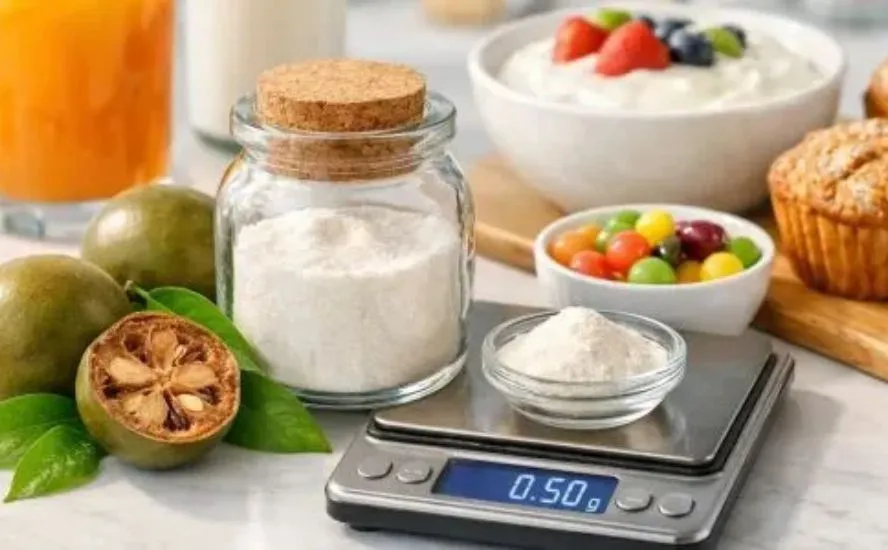
Calculating monk fruit extract dosage looks simple until a batch comes back too sweet, too flat or too costly. The problem is that “monk fruit extract” is not one standardised ingredient. Products differ in mogroside content, sweetness potency and format, so a dosage that works for one extract can fail for another. The food matrix (the mix of ingredients, water, fat, acids and proteins that make up the product) adds another variable.
This guide explains how to calculate monk fruit extract dosage for commercial food formulations step by step, using a formula you can adapt to your own verified specification. It also covers worked examples, application-specific adjustments, pilot validation, cost estimation and supplier checks.
Short answer: divide the amount of sugar you want to match, in grams, by the extract’s verified sweetness equivalence factor. The result is a starting estimate, not a final recipe. You then confirm it through pilot trials, sensory testing and processing checks.
1. What Determines Monk Fruit Extract Dosage in Commercial Food Formulations?
Several factors decide the right monk fruit extract dosage, and no single figure applies across products.
Sweetness potency and mogroside concentration
Mogrosides are the sweet-tasting compounds in monk fruit. Mogroside V is usually the main one. A monk fruit extract powder with a higher mogroside V concentration generally has greater sweetness potency than one with a lower concentration, so you need less of it for the same sweetness. The relationship is a product-specific fact that you should take from documentation, not assume.
Sweetness equivalence
Sweetness equivalence (also called the monk fruit extract sweetness ratio) states how many times sweeter an extract is than sugar by weight. A factor of 100 means 1 g of extract is meant to match about 100 g of sugar in sweetness. Potency can shift with the sweetness level, the temperature and the other ingredients, which is why a datasheet figure is a starting point.
Other variables that move the dose
- Target sweetness level: a product matched to a full-sugar reference needs a different amount than a “reduced sugar” version.
- Existing sugar content: how much sugar you are removing, fully or partly, sets the sweetness you must replace.
- Food matrix: acidity, fat, protein, moisture and flavour compounds change how sweetness is perceived.
- Other sweeteners: blends with polyols, stevia extracts or sugar can change the dose you need and how the sweetness profile develops.
- Product specification: purity, carrier ingredients and format all affect the quantity you weigh into the batch.
A universal dosage does not exist for this reason. Any fixed inclusion rate you see quoted without the extract’s specification, the application and the sugar reference is incomplete.
2. How to Calculate Monk Fruit Extract Dosage Step by Step
The core formula
Initial estimated extract amount (g) = S ÷ R
- S is the target sugar-equivalent amount in grams, meaning the weight of sugar whose sweetness you want to match.
- R is the verified sweetness equivalence factor of the extract, expressed as the number of times sweeter than sugar by weight.
R must come from product-specific data, such as the technical data sheet, or from validated supplier guidance. Do not assume that all monk fruit extracts share the same R.
Step by step
- Set the target sweetness. Define the reference: the full-sugar version of your product, a competitor-neutral internal benchmark or a defined sweetness score from sensory panels.
- Identify the verified sweetness equivalence (R). Use the supplier’s specification for the exact grade and batch type you plan to buy.
- Quantify the sugar being replaced (S). Multiply the sugar percentage in the recipe by the batch weight. If you replace only part of the sugar, use only that part.
- Calculate the initial estimate. Apply S ÷ R.
- Express it as an inclusion rate. Inclusion rate (%) = extract mass ÷ total batch mass × 100. This makes the figure comparable across batch sizes.
- Validate through testing. Run pilot trials and adjust the dose based on sensory and processing results.
Check against mogroside V limits
If your target market states permitted levels as mogroside V, check what your dose delivers:
Mogroside V delivered (g) = extract quantity (g) × mogroside V fraction in the extract
For example, an extract with 25% mogroside V used at 0.08% of the batch contributes 0.02% mogroside V. Limits, where they exist, differ by country and food category, so confirm them for each market.
What the formula does not do
S ÷ R estimates sweetness equivalence only. Sugar also contributes bulk, texture, moisture retention, browning, freezing-point depression, fermentation substrate and preservation effects. A tiny mass of high-intensity extract replaces none of these. The calculation tells you how much sweetness to add. It does not tell you how to rebuild everything else sugar was doing.
3. Worked Examples for Different Commercial Batch Sizes
These figures are hypothetical. The values of R used below are round numbers chosen to make the arithmetic clear. They are not Monk Nectar® product specifications and not industry recommendations. Replace them with verified data for the extract you intend to use.
Example A: Pilot batch
Assumptions: a 10 kg pilot batch of a ready-to-drink beverage. The full-sugar reference contains 8% sugar. You aim to match the sweetness of all of it.
- Sugar in the reference: 10,000 g × 8% = 800 g, so S = 800 g
- Hypothetical R = 100
Initial estimated extract amount = 800 ÷ 100 = 8 g
Inclusion rate = 8 ÷ 10,000 × 100 = 0.08%
How a different verified specification changes the result
| Hypothetical R | Extract for S = 800 g | Inclusion rate in 10 kg batch |
| 100 | 8 g | 0.08% |
| 200 | 4 g | 0.04% |
Doubling the verified sweetness equivalence halves the estimated quantity. This is why you must confirm R before costing or ordering.
Example B: Partial sugar reduction
If you replace only half the sugar, S = 400 g. At a hypothetical R of 100, the estimate is 4 g in the 10 kg pilot. The remaining sugar continues to provide some bulk and texture, which often makes partial reduction easier to manage than full replacement.
Example C: Scaling a validated pilot formula
Suppose the pilot above is tested, adjusted and approved at 8 g per 10 kg. You now plan a 5,000 kg production batch.
Batch-size ratio = 5,000 ÷ 10 = 500
Scaled extract quantity = 8 g × 500 = 4,000 g = 4 kg (still 0.08%)
Mathematical scaling is a starting point only. Mixing time, dispersion, heat history, hold times and equipment differ between pilot and plant. Run a production-scale trial, check sweetness and flavour against the approved pilot sample and document the final specification before commercial release.
4. How to Adjust Dosage for Bakery, Beverages, Confectionery, and Other Food Applications
Each food matrix changes how a given dose behaves. The factors below explain where to look when a calculated dose underperforms.
Beverages
Monk fruit extract for beverages benefits from good dispersion and a clean flavour system. Check solubility in your base, the effect of pH and the impact of any heat treatment such as pasteurisation or hot filling. Acids, flavours and carbonation can all change perceived sweetness. Because beverages contain little else, any sweetness profile problems (delayed onset, lingering sweetness or off-notes) are easy to notice.
Bakery products
In monk fruit extract for bakery products, sugar does far more than sweeten. It builds volume and crumb structure, retains moisture, and drives browning and crust colour. The Monk Nectar® website notes that monk fruit sweetener does not caramelise like sugar, so recipes that rely on browning may behave differently. Heat exposure during baking, the dough or batter’s water activity and the need for bulking agents all affect the outcome. Your formulation team should plan how to replace bulk and texture separately from sweetness.
Confectionery
For monk fruit extract for confectionery, sugar often acts as the main structural component, controlling hardness, set, chew and shelf stability. Replacing it means replacing structure. Bulking ingredients, polyols or fibres are commonly evaluated for this role, with each requiring its own testing. Cooling effects, laxative thresholds for some polyols and processing temperatures need review.
Dairy, frozen foods and nutritional products
Sugar lowers the freezing point of frozen desserts and contributes to mouthfeel in dairy products. Protein and fat can mask or alter sweetness perception. Nutritional and dietary products often combine several functional ingredients, so check compatibility with your existing premix.
Complementary sweeteners and bulking ingredients
Monk fruit extract blending with other sweeteners is a common way to round out a sweetness profile and recover bulk. Whether a blend works depends on the application, the sweeteners involved and the target sweetness curve. Treat any blend as something to develop and validate through pilot work with a qualified food technologist. Monk fruit extract alone does not reproduce every function of sugar.
5. How to Validate Monk Fruit Extract Dosage Before Commercial Production
A calculation produces a hypothesis. Validation turns it into a production specification.
Pilot trials and sensory evaluation
Prepare several versions around the calculated estimate, for example below, at and above the initial dose. Evaluate them against the reference product with trained or consumer panels. Record sweetness intensity, onset, lingering sweetness, aftertaste and overall balance.
Sweetness profiling and aftertaste assessment
Taste the product fresh and again after storage, since perceived sweetness can change as flavours and acidity interact. Assess bitterness or lingering notes. Note that the Monk Nectar® website describes its extract as having a clean taste with no aftertaste, but your own panel results in your own matrix are what matter for release.
Compatibility and processing stability
Test how the extract behaves in your real process: dissolution or dispersion, mixing sequence, heat treatment, pH, holding times and packaging. The Monk Nectar® product page states water solubility and pH and heat stability, but it provides no values. Ask for the supporting data for your conditions rather than relying on a general statement.
Batch consistency and shelf-life evaluation
Run repeat batches to check variation. Include shelf-life testing, covering sweetness, flavour, colour, texture and microbiological stability where relevant. If the ingredient’s sweetness equivalence can vary between lots, check incoming lot certificates against the specification used in your calculation.
Comparing versions and documenting the result
Keep a controlled record of each trial: recipe, extract grade, lot number, calculated dose, process parameters and sensory scores. Choose the version that meets your sweetness, cost and quality targets, then write it into the production specification with tolerances. Involve your food technologists, and consult the supplier’s technical team when you need product-specific data.
6. How to Evaluate Dosage Costs, Ingredient Specifications, and Supplier Suitability
Why concentration drives cost
A higher-potency extract usually needs a smaller dose, but it may cost more per kilogram. The meaningful comparison is cost per unit of sweetness, not price per kilogram. A lower-priced grade can cost more per batch if you need much more of it.
Estimated extract cost per batch = extract quantity required (kg) × purchase price per kg
This formula covers the extract only. It excludes bulking agents, other sweeteners, flavours, processing, packaging, labour and overheads, so it is not the total manufacturing cost.
Illustrative cost example (hypothetical price, for arithmetic only): in Example C, 4 kg of extract at 1,000 currency units per kg gives 4,000 currency units for the extract. If you expect 3% wastage and processing loss, order 4 ÷ 0.97 ≈ 4.12 kg, which brings the estimate to about 4,124 currency units. Replace the price with an actual quotation. This is how you build a realistic monk fruit extract cost per batch and weigh monk fruit extract price and dosage considerations together.
What to check on the specification
- Technical data sheet: mogroside V content, sweetness equivalence, physical form, solubility information and storage conditions.
- Ingredient declaration: how the extract will appear on your label and whether any carrier or additional ingredient is present.
- Food-grade suitability and traceability: confirm the grade is suitable for your food category and that lot traceability exists.
- Quality documentation: certificates of analysis and any certificates the supplier holds, requested and reviewed directly.
Regulations: check market by market
Regulatory status is not the same worldwide. In India, FSSAI has stated that monk fruit extract is treated as a non-specified food ingredient, so approval is needed under the applicable provisions of the Food Safety and Standards Act before it is sold. Other jurisdictions, such as the United States, Canada, Australia and New Zealand, have their own reviews, conditions and use levels, often expressed as mogroside V. Confirm the position for every market where you plan to sell, and take regulatory advice before launch.
Where Monk Nectar® fits
Monk Nectar® is a monk fruit extract supplier based in Ghaziabad, India. Its website lists powder and liquid formats and states that its extract is undiluted and non-blended. The site’s grade listing shows MV 15%, MV 25% and MV 50% powders with sweetness figures of 60×, 100× and 200× sugar, and a liquid grade at 130×. Other pages of the site quote different ranges, so request the current technical data sheet for the exact grade before using any figure in a calculation. The site also states that it offers samples, which makes pilot testing straightforward to arrange. For bulk monk fruit extract enquiries, confirm availability, specifications, pricing and documentation directly with the team, as none of these are published as fixed commitments.
For buyers comparing options, the format question matters. A monk fruit extract powder suits dry blends and premixes, while a liquid grade may suit syrups and beverages. Choose the format that matches your process, then confirm the handling, dispersion and storage guidance with the supplier.
Frequently Asked Questions
How do you calculate monk fruit extract dosage?
Divide the sugar-equivalent weight you want to match (S, in grams) by the extract’s verified sweetness equivalence factor (R). Convert the result to a percentage of batch weight, then validate it through pilot trials.
How much monk fruit extract is needed to replace sugar?
It depends on the extract’s verified potency and how much sugar you replace. With a hypothetical R of 100, replacing 800 g of sugar needs about 8 g of extract. Your own product’s R will give a different number.
Does monk fruit extract concentration affect dosage?
Yes. Extracts with higher mogroside V concentration are generally more potent, so the same sweetness needs less extract. Always use the sweetness equivalence from the technical data sheet for your grade.
Can the same dosage work for bakery products and beverages?
Rarely. Heat, pH, solubility, moisture and the other roles sugar plays differ between the two, so dose each application separately and validate it.
How do manufacturers scale monk fruit extract from a pilot batch to production?
Multiply the validated pilot quantity by the batch-size ratio, then confirm the result in a production-scale trial. Do not rely on arithmetic alone.
Does monk fruit extract replace the bulk and texture of sugar?
No. It replaces sweetness only. Bulk, texture, moisture retention and browning need separate formulation solutions.
How can food manufacturers estimate the cost of monk fruit extract per batch?
Multiply the extract quantity required in kilograms by the purchase price per kilogram, and add an allowance for wastage and processing loss. This covers the extract only.
What specifications should buyers check before calculating dosage?
Check mogroside V content, verified sweetness equivalence, physical form, solubility data, ingredient declaration, food-grade status, traceability and quality documentation. Confirm each against the supplier’s technical data sheet.
Conclusion
To calculate monk fruit extract dosage for commercial food formulations, set the target sweetness, take the verified sweetness equivalence (R) from product documentation, determine the sugar to replace (S), apply S ÷ R and convert the result to an inclusion rate. Then confirm it through pilot trials, sensory testing, stability checks and batch-consistency runs, and cost it with the extract-only formula. The calculation is only as reliable as the specification behind it, and no estimate replaces testing in your own product.
If you are a food manufacturer, product developer or B2B buyer exploring natural sweeteners for commercial formulations, visit Monk Nectar® to review its offering, or enquire about suitable monk fruit extract options and request the technical documentation for the grade you are considering.