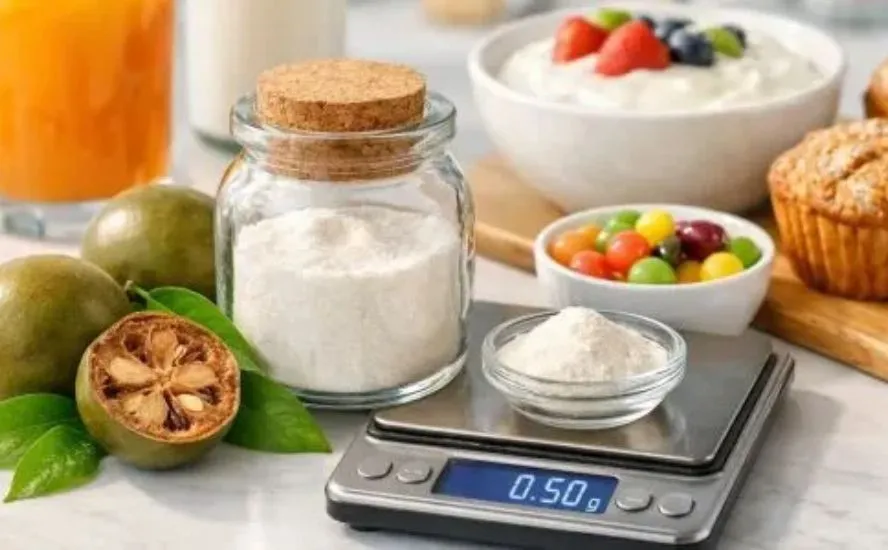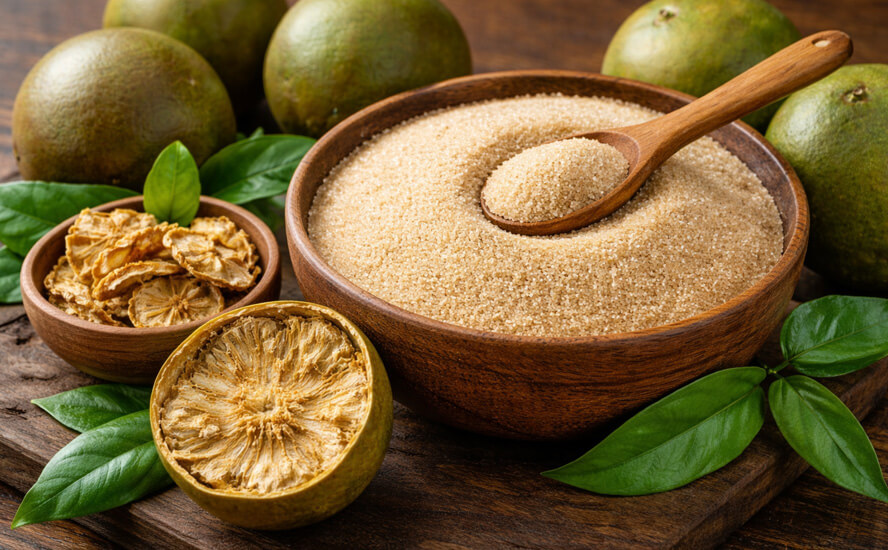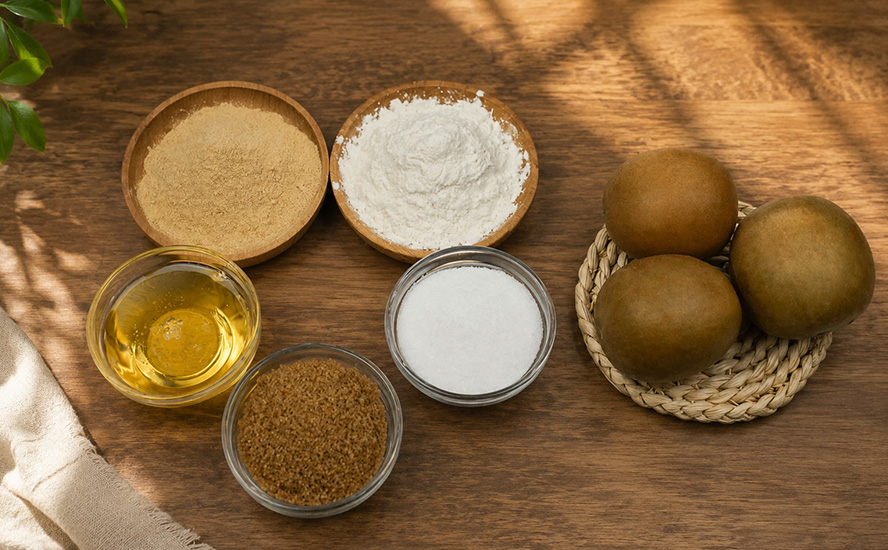
Sugar reduction is no longer a niche trend in Indian food manufacturing. It is a business requirement. Retailers ask for it, regulators are watching added sugar labelling more closely, and consumers now read ingredient panels before they read price tags. This shift has pushed monk fruit extract in bulk to the top of the sourcing list for food manufacturers, beverage brands, bakeries, nutraceutical companies, and HoReCa operators across the country.
But bulk buying is not the same as retail buying. When you purchase a few sachets for home use, a bad batch costs you a few rupees. When you purchase monk fruit extract in bulk for a production line, a poor-quality shipment can cost you an entire batch of finished product, a recall, or a damaged relationship with your own customers. That is why buyers need a clear checklist before they commit to any supplier.
This article walks through exactly what to check before buying monk fruit sweetener in bulk, covering purity, Mogroside V concentration, certifications, batch consistency, storage, packaging, pricing, MOQ, private labelling, and supply chain reliability. Whether you run a bottling plant, a bakery chain, a nutraceutical unit, or a wholesale distribution business, this guide will help you make an informed purchasing decision rather than a rushed one.
What Should You Check Before Buying Monk Fruit Extract in Bulk?
Before signing a purchase order, every buyer should verify six things: purity of the extract, Mogroside V concentration, third-party lab test reports, food safety certifications, batch-to-batch consistency, and the supplier’s ability to maintain supply at scale. Skipping any one of these checks increases the risk of receiving a diluted, inconsistent, or non-compliant product.
Purity Comes First
Monk fruit extract is only as good as the extraction process behind it. A genuine monk fruit extract is derived from the Luo Han Guo fruit through water extraction and purification, with no fillers, no blending agents, and no artificial additives mixed in afterwards. Many products sold as “monk fruit extract” in the market are actually blends, where monk fruit extract is combined with erythritol, maltodextrin, or other bulking agents to cut costs. For a manufacturer formulating a clean-label product, this distinction matters enormously, because a blended product changes your ingredient declaration, your sweetness calculations, and potentially your regulatory claims.
Ask your supplier directly: is this a non-blended, undiluted extract, or a formulated blend? A transparent supplier will answer this without hesitation and will show you documentation to back it up.
Look Beyond the Marketing Claims
Bulk buyers often get swayed by attractive pricing without asking what is actually inside the drum or pouch. Before buying monk fruit extract in bulk, request a certificate of analysis for the specific batch you intend to purchase, not a generic specification sheet from the supplier’s website. A certificate of analysis should show sweetness intensity, Mogroside content, moisture level, and microbial testing results specific to that production run.
How Do You Verify Monk Fruit Extract Quality?
Verifying quality is not about trusting a label. It is about asking for evidence and cross-checking it. Reliable verification methods include reviewing third-party laboratory reports, requesting a free sample before committing to a bulk order, checking food safety certifications, and asking about the supplier’s manufacturing standards and traceability systems.
Request Third-Party Laboratory Testing
Independent lab testing is the single most reliable way to confirm that what is on the label matches what is in the container. Reputable monk fruit extract suppliers routinely test each batch for Mogroside concentration, sweetness equivalence, heavy metals, and microbial safety through accredited third-party laboratories. If a supplier cannot produce recent lab reports for the batch you are buying, treat that as a warning sign rather than a minor inconvenience.
Ask for a Sample Before You Commit
Any serious supplier of bulk monk fruit sweetener should be willing to provide a free sample for testing in your own formulation before you place a large order. This lets your R&D or quality team assess solubility, sweetness profile, aftertaste, and performance under heat or in your specific beverage or bakery application. Never place a large first order without trialling the product in your actual production environment.
Check Manufacturing Standards and Traceability
A trustworthy supplier can tell you where the raw monk fruit was sourced, how it was processed, and which facility handled the extraction and purification. Traceability from fruit to finished extract protects you if a regulatory question ever arises about your own finished product. If a supplier is vague about sourcing or unwilling to share manufacturing details, it usually indicates the product has passed through several unverified hands before reaching you.
Why Is Mogroside V Important When Buying Monk Fruit Extract?
Mogroside V is the specific compound responsible for the clean, intense sweetness in monk fruit extract, and it is the compound regulatory bodies and quality standards typically reference when defining extract grades. Higher Mogroside V concentration generally means a purer, more potent extract that requires less product to achieve the same sweetness, which directly affects your dosing and your cost per kilogram of finished product.
Understanding Extract Grades
Monk fruit extract is typically supplied in different grades based on Mogroside V percentage, and each grade suits different applications:
- Lower Mogroside V grades (around 15 percent) deliver a moderate sweetness intensity, roughly 60 times sweeter than sugar, and work well in applications where monk fruit is used alongside other sweeteners or as a flavour enhancer.
- Mid-range grades (around 25 percent Mogroside V) deliver sweetness in the region of 100 times sugar and are widely used across beverages, dairy, and confectionery.
- Higher grades (around 50 percent Mogroside V) reach intensities of roughly 200 times sugar, making them suitable for applications where a very small dosage is required, such as concentrated syrups or tabletop extract blends.
- Liquid grade extracts, typically around 130 times sweeter than sugar, are popular in beverage manufacturing because they dissolve instantly and integrate smoothly into liquid formulations without any dispersion issues.
Choosing the correct grade for your application is just as important as choosing a reputable supplier. A bakery formulating a low-sugar cookie has very different dosing needs compared to a beverage brand producing a sugar-free soft drink, and matching Mogroside V concentration to your product type helps control costs while maintaining consistent sweetness across every batch.
Why Concentration Consistency Matters More Than a Single High Number
It is not enough for a supplier to advertise a high Mogroside V percentage once. What matters for bulk manufacturing is that every batch you receive, whether it is your first order or your fiftieth, carries the same concentration within a tight tolerance. Inconsistent Mogroside levels between batches force your production team to constantly re-adjust dosing, which slows down manufacturing and creates variability in your finished product’s taste.
What Certifications Should a Monk Fruit Sweetener Supplier Have?
A credible monk fruit sweetener supplier should hold recognised food safety certifications that confirm the product is manufactured, handled, and stored under controlled hygienic conditions. Certifications relevant to food ingredient manufacturing and export-grade quality typically cover food safety management systems, good manufacturing practices, and compliance with applicable Indian food regulations.
Before finalising an order, ask the supplier to share their current certification documents rather than relying on certification badges displayed on a website. Certifications should be current, not expired, and should be verifiable against the issuing body’s records. This is particularly important for nutraceutical companies and pharmaceutical formulators, where ingredient traceability and compliance documentation are often required during their own regulatory audits.
Regulatory and Labelling Considerations in India
Buyers formulating food and beverage products for the Indian market also need to consider how monk fruit sweetener fits into FSSAI labelling requirements, including how sweeteners are declared on ingredient panels and how sugar-free or reduced-sugar claims are worded on packaging. A knowledgeable supplier will be able to guide you on ingredient declaration norms based on the Mogroside grade you are purchasing, helping you avoid labelling errors that could delay a product launch.
Is Monk Fruit Sweetener Suitable for Food Manufacturing, Beverages, and Baking?
Yes, monk fruit sweetener is widely suited to commercial food manufacturing, and different grades are formulated specifically for different applications, including beverages, dairy, confectionery, frozen desserts, nutritional and dietary products, and tabletop sweeteners. Its zero-calorie, zero-glycemic profile makes it particularly attractive for diabetic-friendly and keto-friendly product lines.
Beverage Formulation
Liquid grade monk fruit extract disperses cleanly in water-based and acidic beverage formulations, making it a strong fit for soft drinks, flavoured waters, ready-to-drink teas, and functional beverages. Because it does not leave a bitter aftertaste, which is a common complaint with several artificial sweeteners, it helps beverage brands maintain a clean flavour profile that consumers actually enjoy on repeat purchase.
Bakery Applications
Bakeries substituting sugar with monk fruit extract need to account for two practical differences. First, monk fruit extract does not caramelise or brown the way sugar does, so recipes relying on browning for colour and texture may need reformulation, such as adding a small amount of an alternative browning agent. Second, because monk fruit extract is many times sweeter than sugar by weight, dosing needs to be recalculated rather than substituted on a like-for-like basis. Working closely with a supplier who understands these formulation nuances saves significant time during product development.
Dairy, Confectionery, and Nutraceutical Use
Monk fruit extract’s heat stability and pH stability make it workable across pasteurised dairy products, confectionery applications, and nutraceutical formulations such as sugar-free syrups, chewables, and functional powders. Its compatibility with vegan, gluten-free, and non-GMO product positioning also makes it attractive for brands targeting the clean-label and better-for-you segments of the Indian market.
How Do You Choose a Reliable Monk Fruit Sweetener Supplier for Bulk Orders?
Choosing a reliable monk fruit sweetener supplier in India comes down to evaluating five practical factors: consistent product quality across batches, transparent documentation, realistic lead times, flexible order quantities, and dependable after-sales support. A supplier who scores well on all five is far more likely to support your production schedule without disruption.
Batch Consistency and Supply Chain Reliability
For a manufacturer running continuous production, nothing is more disruptive than a supplier who delivers excellent quality on the first order and inconsistent quality on the next. Ask potential suppliers how they control batch-to-batch variation, whether they maintain buffer stock, and how they manage supply during periods of high demand. A supplier with a stable, well-managed supply chain will be able to answer these questions with specifics rather than vague reassurances.
Lead Times and MOQ
Lead time and minimum order quantity directly affect your production planning and working capital. Before committing to a supplier, clarify their standard lead time for bulk orders, whether expedited dispatch is available for urgent requirements, and what MOQ applies to different pack sizes and grades. A supplier offering flexible MOQ options is particularly useful for smaller bakeries, HoReCa businesses, and start-up nutraceutical brands that want to test monk fruit sweetener wholesale before scaling up their order volumes.
Bulk Pricing Considerations
Bulk pricing for monk fruit extract should reflect the Mogroside V grade, packaging format, and order quantity, and larger commitments generally unlock meaningful cost efficiencies. However, price should never be evaluated in isolation. A slightly higher price per kilogram from a supplier offering verified purity, consistent Mogroside levels, and reliable dispatch will almost always work out cheaper than a discounted product that causes formulation issues or delayed shipments. When comparing quotes from different suppliers, ask each one to break down pricing by grade and packaging so you are comparing like with like.
Private Labelling and OEM Manufacturing Support
Many food brands, nutraceutical companies, and retailers want to launch their own branded monk fruit sweetener products without setting up extraction facilities themselves. A capable supplier offering private labelling and OEM manufacturing support allows these businesses to source high-purity extract in bulk and package it under their own brand, complete with customised specifications for sweetness intensity and format. This is a practical route for retailers and wholesalers who want to enter the natural sweetener category without the capital investment of building manufacturing infrastructure.
How Should Monk Fruit Sweetener Be Stored, and What Is Its Shelf Life?
Monk fruit sweetener should be stored in a cool, dry place away from direct sunlight and moisture, in tightly sealed packaging to prevent clumping in powder form or contamination in liquid form. When stored correctly, monk fruit extract typically maintains its quality and sweetness intensity for an extended shelf life, though buyers should always confirm the specific shelf life and storage recommendations printed on the batch documentation from their supplier, since this can vary slightly by grade and packaging format.
Packaging Quality Matters for Bulk Shipments
For bulk monk fruit extract, packaging is not just about protecting the product during transit. It also affects shelf life and ease of handling on your production floor. Look for suppliers offering food-grade packaging appropriate to your order size, whether that is smaller pouches for trial orders or larger drums and containers for continuous manufacturing use. Properly sealed, moisture-resistant packaging reduces the risk of caking in powder grades and contamination in liquid grades, both of which can affect consistency once the product reaches your production line.
Storage Handling for Manufacturing Facilities
Once the product arrives at your facility, maintain first-in-first-out stock rotation, store containers off the floor, and avoid repeated opening and resealing of bulk packaging, which introduces moisture and reduces shelf stability over time. These simple handling practices protect your investment and ensure the extract performs consistently every time it goes into production.
Where Can Businesses Buy Monk Fruit Sweetener in Bulk in India?
Businesses across India, from bakeries and beverage manufacturers to nutraceutical companies and wholesale distributors, can source monk fruit sweetener in bulk directly from established Indian suppliers who specialise in natural sweetener manufacturing and distribution. Buying directly from a specialised supplier, rather than through multiple intermediaries, generally results in better pricing, fresher stock, more transparent documentation, and more responsive support when questions arise about a specific batch.
When evaluating where to buy monk fruit sweetener wholesale, prioritise suppliers who can demonstrate direct sourcing relationships, maintain their own quality testing processes, and offer dedicated support for bulk and repeat orders rather than treating your business as a one-time transaction. For manufacturers researching the best monk fruit sweetener in india for their specific application, comparing suppliers on purity, Mogroside grade options, and documented lab testing will narrow the choice considerably.
Why Choose Monk Nectar® for Bulk Monk Fruit Sweetener Requirements?
Monk Nectar® supplies 100 percent pure, non-blended monk fruit extract in both liquid and powder form, with no fillers, no artificial additives, and zero adulteration. Every grade in the Monk Nectar® range, from 15 percent to 50 percent Mogroside V powder formats through to liquid grade extract, is plant-derived and highly purified, giving food manufacturers, beverage brands, bakeries, and nutraceutical companies a dependable, undiluted ingredient they can build a clean-label product around.
As part of the JJD Enterprises Group, operating in the food ingredient space since 2010, Monk Nectar® brings established manufacturing experience and a professional supply team to every order, serving thousands of clients across the dairy, bakery, beverages, confectionary, snacks, and pharmaceutical sectors. This experience translates into practical support for buyers, including guidance on selecting the right grade for your application, free samples for trial before you commit to a bulk order, and dedicated assistance throughout your ordering process.
For businesses researching pure monk fruit extract india options for a new product launch or an existing reformulation project, Monk Nectar® offers the purity, documentation, and consistency that bulk manufacturing demands, without the guesswork that comes with unverified suppliers.
Making the Right Choice When Buying Monk Fruit Sweetener in Bulk
Buying monk fruit sweetener in bulk is a decision that affects your product quality, your production costs, and ultimately your customers’ trust in your brand. The checklist is straightforward but non-negotiable: verify purity and Mogroside V concentration, insist on third-party lab testing and valid food safety certifications, confirm batch-to-batch consistency, understand storage and shelf life requirements, and choose a supplier who can maintain reliable supply at the volumes your business needs.
Cutting corners on any of these points might save a small amount on your first invoice, but it rarely saves money over the life of your product line. A supplier who can answer every question on this checklist with documentation, not just assurances, is the supplier worth building a long-term relationship with.
Monk Nectar® has built its reputation on exactly this kind of transparency, offering pure, non-blended monk fruit extract across multiple Mogroside grades, backed by documented quality standards and a supply team that understands the practical needs of Indian food manufacturers, beverage brands, bakeries, HoReCa businesses, wholesalers, and retailers.
Ready to source premium monk fruit sweetener in bulk for your business?
Contact Monk Nectar® today to request a free sample, discuss your MOQ and private labelling requirements, and get a bulk pricing quote tailored to your application. Reach out at info@monkfruit.in or call +91-9873527768 to start a conversation with a supplier that treats your production line as seriously as you do.
Frequently Asked Questions
What should you check before buying monk fruit sweetener in bulk?
Check the purity of the extract, the Mogroside V concentration, third-party lab test reports for the specific batch, valid food safety certifications, batch-to-batch consistency, and the supplier’s ability to maintain reliable supply at your required volume.
How do you choose a reliable monk fruit sweetener supplier?
Look for a supplier who provides transparent documentation, offers free samples for trial, maintains consistent Mogroside levels across batches, has realistic and clearly stated lead times, and offers flexible MOQ options for growing businesses.
What is the best monk fruit sweetener in bulk for commercial use?
The best option depends on your application. Beverage manufacturers often prefer liquid grade extract for easy dispersion, while bakeries and confectionery producers typically choose powder grades between 25 percent and 50 percent Mogroside V depending on the sweetness intensity required.
Is monk fruit extract suitable for food manufacturing?
Yes, monk fruit extract is widely used across beverages, dairy, confectionery, frozen desserts, nutritional and dietary products, and tabletop extract due to its zero-calorie, zero-glycemic, heat-stable, and pH-stable properties.
How do you verify monk fruit extract quality?
Verify quality by requesting a certificate of analysis for the specific batch, checking Mogroside V concentration, reviewing third-party lab testing results, confirming food safety certifications, and trialling a free sample in your own formulation before ordering in bulk.
What certifications should a monk fruit supplier have?
A credible supplier should hold recognised food safety management certifications, follow good manufacturing practices, and comply with applicable Indian food regulations, with current documentation available for review on request.
What purity should bulk monk fruit extract contain?
Bulk monk fruit extract should be 100 percent pure and non-blended, with no fillers, artificial additives, or bulking agents mixed in, and the Mogroside V concentration should match what is stated on the certificate of analysis for that batch.
Where can businesses buy monk fruit extract in bulk in India?
Businesses can buy monk fruit extract in bulk directly from specialised Indian suppliers who manufacture and test their own extract, offering better pricing, fresher stock, and clearer documentation compared to multi-layered distribution chains.
How should monk fruit extract be stored?
Monk fruit extract should be stored in a cool, dry place away from direct sunlight and moisture, in tightly sealed food-grade packaging, following the specific shelf life and storage guidance provided by the supplier for that batch and grade.
Why is Mogroside V important?
Mogroside V is the compound responsible for monk fruit extract’s clean, intense sweetness. Higher concentrations generally mean a purer, more potent extract that requires smaller dosing to achieve the same sweetness in a finished product.
Is monk fruit extract suitable for beverages and baking?
Yes, though formulation approaches differ. Liquid grade extract works well in beverages due to easy dispersion, while bakery applications need to account for the fact that monk fruit extract does not caramelise or brown like sugar, requiring recipe adjustments.
Why choose Monk Nectar® for bulk monk fruit extract?
Monk Nectar® offers 100 percent pure, non-blended monk fruit extract across multiple Mogroside V grades and liquid format, backed by manufacturing experience since 2010, free samples for trial, and dedicated support for bulk orders, private labelling, and OEM manufacturing requirements.